Do We Really Have Free Will?
abracad, · Categories: science and spiritualityThe question of whether we really have free will is fundamental to understanding the purpose and nature of our very existence.
What is Free Will?
Free will can be defined as an individual (human or other living entity) having the capacity to determine its own actions, and to some degree destiny, i.e. within the limits of external circumstance.
Free will is able to act in a meaningful, non-caused, non-random way to optimize fulfillment of certain goals, eg:
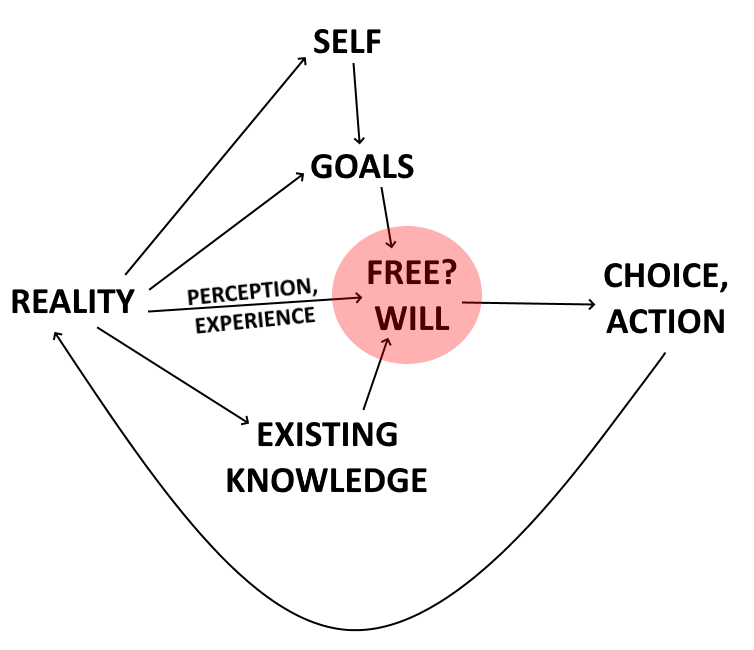
Models of Reality
Determinism
Determinism results from the absolute rule of cause and effect. In the Newtonian clockwork universe, every precise detail of the future is already determined to an infinitesimal degree of accuracy, and has been so since the start of time. There is no scope for straying from the cosmic script.
Determinism is intuitively reasonable. I push an object, it moves in the direction of my force. The universe, including ourselves, consists of matter and energy in motion behaving according to eternal all-encompassing laws. Thus every tiny detail of the universe's, and our, is already fixed and has been so since the beginning of existence.
This begs the question of whether existence has a finite beginning, and if so what "caused" or preceded it? But if something caused it, then that something pre-existed existence and so what might be labelled the "big bang" was not in fact the beginning at all.
Randomness
The currently preferred scientific explanation for the underlying nature of what we perceive as the universe is quantum physics. This theory, well supported by experimental evidence, postulates that rather than being deterministic (as the universe appears to our senses) at the sub-atomic level the universe contains inherent indeterminacy / "randomness", in that it is not possible to predict precisely the behavior of a given particle, only to calculate probabilities. The apparent determinism we perceive is due to the large numbers of such sub-atomic events which form our concept of reality. The toss of a coin is unpredictable, the toss of a million coins will result in around half a million heads, half a million tails.
It is as though quantum theory acts as an impenetrable veil limiting the degree to which the universe may be understood.
However, while quantum randomness breaks the shackles of complete determinism, it does not imply the existence of free will.
Non-physical Reality (Spirit, God?)
In response to the idea of quantum randomness Einstein famously remarked: “God does not play dice with the universeâ€. But might this apparent randomness actually be caused by something non-physical, beyond the material universe? Something that numerous cultures throughout history have called God or Spirit?
Both determinism and the indeterminacy of quantum theory suggest a world without free will. In the former case everything is predetermined, thus there is no room for an entity such as the will acting as a cause without itself being caused. In the latter, even without deterministic predictability, each micro-event is random, subject to probability rather than a supernatural will. Even though we cannot predict the toss of a single coin, we CAN predict the toss of a million coins will result in around half a million heads, half a million tails.
The existence of free will requires the actions of individuals be consciously and intelligently determined, at least some of the time, rather than being the inevitable product of the past or due to chance subatomic events. This requires some entity (the will) being able to act as a cause, without its action being caused by anything else.
If free will exists it is highly suggestive of the existence of some non-physical entity ("spirit") from which that will emanates. The question of whether some higher non-physical entity ("God") might exist is not discussed here. If free will does not exist then the entire future of the universe has already been fixed and life and experience are meaningless.
NB1: there is no mechanism in known science (physics, chemistry, biology, psychology.....) that explains how free will might operate, or even what entity might exert that will.
NB2: an alternative, if bizarre, explanation postulates the existence of an infinite number parallel universes (multiverse). At each moment an infinite number of possible futures exist, each spawning its own universe, which in turn holds an infinite number of possible futures. And so on and so forth.
Intuitive Argument for Free Will
Max Planck, a founder of quantum theory and a firm believer in determinism, conceded "...we have our most direct and intimate source of knowledge, which is the human consciousness telling us that in the last resort our thought and volition are not subject to ... causal order", [quoted in New Pathways in Science. Sir Arthur Eddington MA, DSc, LLD, FRS; pub Cambridge University Press 1935].
On the one hand scientific knowledge and common sense suggest a deterministic universe, unfolding in accordance with prescriptive natural laws. On the other hand experience (of having control of our actions), observation and common sense suggest the existence of free will.
Just about every modern society has independently developed laws that seek to maintain order through the threat of punishment for those that violate these laws. Our laws pre-suppose the reality of free will; how can an individual be punished for behavior that was completely beyond their volition?
Numerous independently developed religions contain moral codes that if obeyed lead to eternal joy, but if flouted result in eternal damnation. How, morally, can a fate based upon moral conduct, depend on actions over which we have no control?
How much energy and resources are devoted to pursuits, such as art, literature etc., which are unrelated to the survival and evolution of the species? If we have no choice, why should deterministic fate humor such distractions?
Why should the corporate world devote so much time, effort and money on advertising and marketing if its intended audience has no choice in how to spend its hard earned cash?
Almost every aspect of our very existence is built upon the assumption of the reality of free will.
How often do we encounter situations in which we have a choice; whether to order fish or chicken, whether to watch channel 1 or channel 2, whether to go jogging or have a lie in etc. And at various times we face life-changing choices, whether to change job, marry, move home etc. How certain we are that we do have the power to determine our destiny. And yet once the choice is made how can we really be sure that we could have chosen differently. An almighty paradox.
Pascal’s Wager and Free Will
The 17th century philosopher, mathematician and physicist Blaise Pascal proposed an argument in favour of belief in God on the basis that such belief was most beneficial in the case of it being right and least damaging in the case of it being wrong.
A similar argument can be made for the acceptance of free will. If correct, believers will make conscious effort to live purposefully and achieve more than those incorrectly deny. However, if wrong, and free will does not exist, then our destiny is unalterable and identical to that of those who correctly deny.
How Might Free Will Operate?
Libet Experiment
In the 1980s scientist Benjamin Libet conducted experiments in which subjects were asked to make an action (eg flicking their wrist) at a random time, see The Libet Experiment and its Implications for Conscious Will, Peter G.H. Clarke; Libet Experiments, The Information Philosopher. Libet's results showed electrical "readiness" signals in the subject's brain before they consciously decided to act. Libet's work has been interpreted by some as a refutation of human free will; however, it is possible that a free decision is made unconsciously, ahead of both the brains electrical activity and the conscious awareness of 'deciding' - ie consciousness is not necessarily equivalent to self, it may be just a reflection of it, eg the mind has both conscious and unconscious parts.
Quantum Effects in the Brain
By what mechanism might free will operate? For free will to exist there needs to be a means by which the will may act as a cause upon physical reality. It seems quantum physics may offer a clue as to the nature of this mystical interface.
Physicist Henry Margenau [quoted by Sir John Eccles in Mindwaves: thoughts on intelligence, identity and consciousness. Ed. Blakemore & Greenfield; pub Blackwell 1987] states that the components of the brain 'are small enough to be governed by probabilistic quantum laws' and are 'always poised for a multitude of possible changes, each with a definite probability'.
Professor Sir Roger Penrose FRS has postulated that microtubules, found within brain neurons, are subject to quantum effects and that these quantum effects may be propagated to the neuron and macro level. Eg, see Quantum Consciousness, the website of Professor Stuart Hameroff MD of the University of Arizona, who has worked with Penrose on developing this theory; and Discovery of quantum vibrations in 'microtubules' corroborates theory of consciousness, Phys.org Jan 2014. In Life on the Edge Johnjoe McFadden and Jim Al-Khalili present evidence for the significance of quantum effects in biology.
The existence of free will is suggestive of a greater reality encompassing but consisting of more than physical reality in which the non-physical realm is able to influence the physical. But, how does this non-physical component determine when to influence the physical? How does it determine its goals? Given a certain state of its reality is it free to differ from what it does?
The Implications of Free Will
If free will exists it is highly likely that it originates from something beyond the material realm (which exhibits no properties capable of supporting an entity such as will). Should this non-physical entity ("spirit") exist, it is unlikely to be affected by a physical event such as death. We may therefore infer that our essence (i.e. will, consciousness) is infinite, and therefore that our earthly experience is of little significance.
If, however, there is no free will, it follows that we are mere automata acting out a pre-prepared script. Sorrow and elation are mere illusions; inevitable, and thus meaningless. Death is similarly inconsequential since there is ultimately no such thing as life.
Both the existence of free will and its absence imply the relative insignificance of this incarnation. A single human lifetime is but 0.000000005 times the estimated age of the universe, if the age of the universe is represented by one day, a human life lasts a mere 0.0004 seconds! The most significant members of today's world will be mere historical footnotes in 1,000 years and shall most likely be forgotten in 10,000. Though we should seek to fully exploit our life, and whilst we can hope for continued existence, we may take heart that our earthly problems and failings are ultimately of no importance whatsoever.
It may be that our existence is almost entirely deterministic/random, with but a tiny fraction dependant upon our will. It may be that without conscious effort to apply our will we tend to drift through life completely deterministically (with a little quantum randomness), reacting instinctively to external stimuli. This is essentially the philosophy of the mystic G I Gurdjieff, see G. I. Gurdjieff: The War Against Sleep by Colin Wilson. Such a view encourages constant review and exercise of the will in trivial ways to strengthen its capacity in order that we might maximize our potential to take charge of our destiny.
See also:

Filed in: science and spirituality
Leave a Reply